Wednesday, 17 October 2018

Dr, Shanti S Bhatnagar

DR.SHANTI SWAROOP BHATNAGAR
Father of Research Laboratories
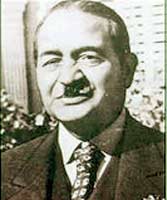

Dr. Shanti Swaroop Bhatnagar
QUICK FACTS
NAME: Shanti Swaroop Bhatnagar
OCCUPATION: Scientist
BIRTH DATE: February 21, 1894
DEATH DATE: January 1, 1955
PLACE OF BIRTH: Pakistan

Dr. Shanti  Swaroop Bhatnagar is known as 'The Father of Research Laboratories'. He is remembered for having established various chemical laboratories in the country.
He was born in Bera, Punjab. After completing his M.Sc in India he went to England on a fellowship. On his return he served as a professor in Benaras Hindu University. He used to spent all his spare time in his laboratory doing research.
He was awarded the title 'Sir' by the British in recognition of his service to Science, in 1941. As Nehru was much in favour of scientific development after Independence, Council of Scientific and Industrial Research was set up under the chairmanship of Dr. Bhatnagar. Later, he was awarded 'Padma Bhushan'. He became the first director-general of the Council of Scientific and Industrial Research (CSIR) in 1940. After his death, CSIR established a Bhatnagar Memorial award for eminent scientists in his honour.

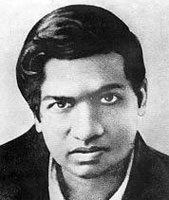
Seinivasa Ramanujan

SRINIVASA RAMANUJAN
Mathematician


Srinivasa Ramanujan
QUICK FACTS
NAME: Srinivasa Ramanujan
OCCUPATION: Mathematician
BIRTH DATE: December 22, 1887
DEATH DATE: April 26, 1920
PLACE OF BIRTH: Erode

Srinivasa Ramanujan  was a great Mathematician, who became world  famous at the age of twenty six. He was born at Erode in Tamil Nadu on 22 December 1887. 
Ramanujan could not complete his college education because of illness. He was so interested in mathematics that he learned on his own. He found out new formulas for solving mathematical problems and wrote articles about them. Professor Hardy a scientist in the Cambridge University saw one his article and impressed by his knowledge, took Ramanujan to England.  
Ramanujan was considered as the master of theory of numbers. The most outstanding of his contributions was his formula for p (n), the number of 'partitions' of 'n'. It was in 1914, while he was working in Trinity College he developed the 'Number Theory' and for his valuable contribution, was elected fellow of Trinity College on 18th October 1917. He returned to India in 1919 and began Research. He passed away on 26 April 1920. Government of India issued a commemorative stamp in his honour. Indian National Science academy and many other scientific institutions in India are giving various awards in memory of this brilliant mathematician.

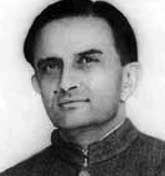
Vikram A Sarabhai

VIKRAM.A.SARABHAI

2nd chairman of Indian Atomic Energy Commission and Indian Space Research Organisation


Vikram.A.Sarabhai
QUICK FACTS
NAME: Vikram Sarabhai
OCCUPATION: Physicist
BIRTH DATE: August 12, 1919
DEATH DATE: December 31, 1971
PLACE OF BIRTH: Ahmedabad

Vikram.A.Sarabhai,  was the main personality behind the launching of India's first satellite, Aryabhata in 1975. He was born in Ahmedabad, Gujarat  in a family of industrialists. He was also responsible for the Equatorial Rocket Building Station at Thumba.
Sarabhai set up the Ahmedabad Textile Industries Research Association, a laboratory for research in Physics and the Indian Institute of Management. Sarabhai was the second chairman of India's Atomic Energy Commission and the Indian Space Research Organisation.
Sarabhai's study of cosmic rays under the eminent scientist Dr. C.V. Raman, revealed that cosmic rays are a stream of energy particles reaching the earth from the outer space, being influenced on their way by the sun, the atmosphere and magnetism. This study helps in observing terrestrial magnetism and the atmosphere, the nature of the sun and outer space. He was conferred 'Padma Shri' in 1966 and was posthumously awarded 'Padma Vibushan' in 1972. He was also awarded 'Dr. Shanti Swarup Bhatnagar Prize' in 1962. This great scientist could be credited with launching India into space age.

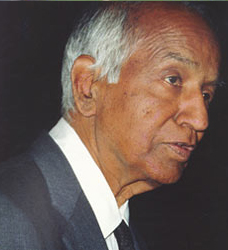
Dr. H Khorana

Dr. HARGOBIND KHORANA
Nobel Prize Winner


Dr. HARGOBIND KHORANA
QUICK FACTS
NAME: Dr. Hargobind Khorana
OCCUPATION: Biochemist
BIRTH DATE: January 9, 1922
DEATH DATE: November 9, 2011
PLACE OF BIRTH: Chhattisgarh

Dr. Hargobind Khorana was born on 9th January 1922 at Raipur, Punjab (now in Pakistan). Dr.Khorana was responsible for producing the first man-made gene in his laboratory in the early seventies. This historic invention won him the Nobel Prize for Medicine in 1968 sharing it with M.W. Nuremberg and R.W. Holley for interpreting the genetic code and analyzing its function in protein synthesis. They all independently made contributions to the understanding of the genetic code and how it works in the cell.
Khorana, born into a poor family attended D.A.V. High School in Multan, took his M.Sc from Punjab University at Lahore and in 1945 he went to England on a government scholarship and obtained a PhD from the University of Liverpool (1948). Dr. Khorana spent a year in Zurich in 1948-49 as a post-doctoral fellow at the Swiss Federal Institute of Technology and returned to India for a brief period in 1949.
He returned to England in 1950 and spent two years on a fellowship at Cambridge and began research on nucleic acids under Sir Alexander Todd and Kenner. His interest in proteins and nucleic acids took root at that time. In 1952 he went to the University of British Columbia, Vancouver on a job offer and there a group began to work in the field of biologically interesting phosphate esters and nucleic acids with the inspiration from Dr. Gordon M. Shrum and Scientific counsel from Dr. Jack Campbell.  In 1960 he joined the University of Wisconsin as Professor and co-Director of the Institute of Enzyme Research and Professor of Biochemistry (1962-70) and became an US citizen. Khorana continued research on nucleic acid synthesis and prepared the first artificial copy of a yeast gene. Dr. Khorana is also the first to synthesize oligonucleotides, that is, strings of nucleotides. These custom designed pieces of artificial genes are widely used in biology labs for sequencing, cloning and engineering new plants and animals. The oligo nucleotides, thus, have become indispensable tools in biotechnology. In 1970 he became the Alfred Sloan Professor of Biology and Chemistry at the Massachusetts Institute of Technology, USA. Khorana now settled in America,  is married to Esther Elizabeth Sibler from Switzerland and they have three children.
Apart from the Nobel Prize, Khorana has won many awards and honors for his achievement. Distinguished Service Award, Watumull Foundation, Honolulu, Hawaii (1968); American Academy of Achievement Award, Philadelphia, Pennsylvania (1971); Padma Vibushan, Presidential Award, India (1972); J.C.Bose Medal, Bose Institute, Calcutta (1972) and Willard Gibbs medal of the Chicago Section of American Chemical Society (1973-74). He was elected a member of the National Academy of Sciences, Washington as well as a Fellow of the American Association for the Advancement of Science. In 1971 he became a foreign member of USSR Academy of Sciences and in 1974 an Honorary Fellow of the Indian Chemical Society.
Khorana's work, which is an important scientific landmark of the twentieth century, has brought closer the day when synthetic DNA may be introduced into the defective human tissues to bring about their repair or treat mentally retarded people and change them into more intelligent and healthy human beings. His synthesis of RNA, capable of replication in laboratory, is a step towards the creation of life artificially. In fact, the researches has opened up a new branch called Genetic Engineering in Science. 

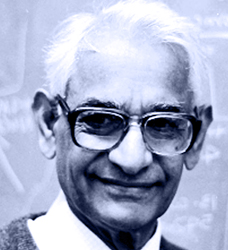
Dr. S Chandrasekhar

SUBRAMANYAN CHANDRASEKHAR

Asrtophysicist, Nobel prize winner

Subrahmanyan Chandrasekhar
QUICK FACTS
NAME: Subrahmanyan Chandrasekhar
OCCUPATION: Scientist
BIRTH DATE: October 19, 1910
DEATH DATE: August 21, 1995
PLACE OF BIRTH: Lahore

Subrahmanyan Chandrasekhar, a Nobel Laureate in Physics and one of the greatest astrophysicists of modern times was born on October 19, 1910 in Lahore, (now in Pakistan) to parents Chandrasekhara Subrahmanya Ayyaa civil servant and Sita Balakrishnan. Being the nephew of the great, C.V. Raman, a Nobel Prize winner in Physics young  Chandrashekhar's interest in the subject came naturally to him. 
In 1930, at the age of 19, he completed his degree in Physics from Presidency College, Madras and went to England for postgraduate studies at the Cambridge University. Chandrasekhar was noted for his work in the field of stellar evolution, and in the early 1930s he was the first to theorize that a collapsing massive star would become an object so dense that not even light could escape it; now known as the Black hole. He demonstrated that there is an upper limit ( known as 'Chandrasekhar Limit' ) to the mass of a White dwarf star. His theory challenged the common scientific notion of the 1930s that all stars, after burning up their fuel, became faint, planet-sized remnants known as white dwarfs. But today, the extremely dense neutron stars and black holes implied by Chandrasekhar's early work are a central part of the field of astrophysics.
Initially his theory was rejected by peers and professional journals in England. The distinguished astronomer Sir Arthur Eddington publicly ridiculed his suggestion that stars could collapse into such objects( black holes). Disappointed, and reluctant to engage in public debate, Chandrasekhar moved to America and in 1937 joined the faculty as an Assistant Professor of Astrophysics at the University of Chicago and remained there till his death. At Chicago, he immersed himself in a personalized style of research and teaching, tackling first one field of astrophysics and then another in great depth. He wrote more than half a dozen definitive books describing the results of his investigations. More than 100,000 copies of his highly technical books have been sold. He also served as editor of the Astrophysical Journal, the field's leading journal, for nearly 20 years; presided over a thousand colloquia; and supervised Ph.D. research for more than 50 students.
Chandrasekhar was a creative, prolific genius whose ability to combine mathematical precision with physical insight changed humanity's view of stellar physics. In addition to his work on star degeneration, he has contributed significantly to many disparate branches of physics, including rotational figures of equilibrium, stellar interiors, radiative transfer of energy through the atmospheres of stars, hydro magnetic stability and many others. He won the Nobel Prize in 1983 and received 20 honorary degrees, was elected to 21 learned societies and received numerous awards in addition to the Nobel Prize, including the Gold Medal of the Royal Astronomical Society of London; the Royal Medal of the Royal Society, London; the National Medal of Science, the Rumford Medal of the American Academy of Arts and Sciences; and the Henry Draper Medal of the National Academy of Sciences. NASA's premier X-ray observatory was named the Chandra X-ray Observatory in his honor. 
He and his wife, Lalitha became American citizens in 1953. This genius passed away on 21 August 1995 in Chicago, Illinois, USA..

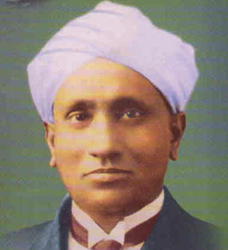
C V Raman

CHANDRASEKHAR VENKATA RAMAN

(Physicist, Nobel Prize Winner)

C.V.Raman
QUICK FACTS
NAME: C. V. Raman
OCCUPATION: Physicist
BIRTH DATE: November 7, 1888
DEATH DATE: November 21, 1970
PLACE OF BIRTH: Thiruvanaikaval

C.V.Raman was a scientist in Physics, who won nobel prize in 1930. His discovery of the 'Raman Effect' made a very distinctive contribution to Physics. He was knighted by the British Government in 1929. He was also conferred the highest title of 'Bharat Ratna' in 1954.
Raman was born on 7th November,1888 at Ayyanpettai in Tamil Nadu. He had his education in Visakhapatanam and Madras. After getting top ranking in the Financial Civil Service Competitive Exam, he was appointed as Deputy Accountant General in Calcutta (Kolkata). In 1917 he became the professor of Physics at the Calcutta University. After 15 years service at the Calcutta University, Raman shifted to Bangalore and became the Director of the Indian Institute of Science in 1933. In 1943 he founded 'Raman Research Institute', near Bangalore.
The 'Raman Effect' was a demonstration of the 'Collision' effect of light bullets (photons) passing through a transparent medium, whether solid, liquid or gaseous. Raman's publications include 'Molecular Diffraction of Light', 'Mechanical Theory of Bowed Strings' and 'Diffraction of X-ray's', 'Theories of Musical Instruments' etc. Raman conducted pioneering research in musical acoustics, particularly on Tamboura, the well known Indian musical instrument.

cities at bank of river

list of cities in India located on the banks of a river.


StateCityRiver
Uttar PradeshAgraYamuna
GujaratAhmedabadSabarmati
Uttar PradeshAllahabadAt the confluence of Ganga, Yamuna and Saraswati
Uttar PradeshAyodhyaSaryu
UttarakhandBadrinathAlaknanda
OdishaBankiMahanadi
OdishaBrahmapurRushikulya
OdishaChhatrapurRushikulya
BiharBhagalpurGanges
West BengalKolkatahugli
OdishaCuttackMahanadi
DelhiNew DelhiYamuna
AssamDibrugarhBrahmaputra
PunjabFerozpurSutlej
AssamGuwahatiBrahmaputra
UttarakhandHaridwarGanges
TelanganaHyderabadMusi
Madhya PradeshJabalpurNarmada
Uttar PradeshKanpurGanges
RajasthanKotaChambal
KeralaKottayamMeenachil
Uttar PradeshJaunpurGomti
BiharPatnaGanges
Andhra PradeshRajahmundryGodavari
Jammu & KashmirSrinagarJhelum
GujaratSuratTapi
Tamil NaduTiruchirapalliKaveri
Uttar PradeshVaranasiGanges
Andhra PradeshVijayawadaKrishna
GujaratVadodaraVishwamitri
Uttar PradeshMathuraYamuna
Uttar PradeshMirzapurGanga
Uttar PradeshAuraiyaYamuna
Uttar PradeshEtawahYamuna
KarnatakaBangaloreVrishabhavathi
Uttar PradeshFarrukhabadGanges
Uttar PradeshFatehgarhGanges
Uttar PradeshKannaujGanges
KarnatakaMangaloreNetravati, Gurupura
KarnatakaShimogaTunga River
KarnatakaBhadravathiBhadra
KarnatakaHospetTungabhadra
KarnatakaKarwarKali
KarnatakaBagalkotGhataprabha
KarnatakaHonnavarSharavathi
Madhya PradeshGwaliorChambal
Uttar PradeshGorakhpurRapti
Uttar PradeshLucknowGomti
Uttar PradeshKanpur CantonmentGanges
Uttar PradeshShuklaganjGanges
Uttar PradeshChakeriGanges
MaharashtraMalegaonGirna River
OdishaSambalpurMahanadi
OdishaRourkelaBrahmani
MaharashtraPuneMula, Mutha
DamanDamanDaman Ganga River
Tamil NaduMaduraiVaigai
Tamil NaduThiruchirapalliKaveri
Tamil NaduChennaiCooum, Adyar
Tamil NaduCoimbatoreNoyyal
Tamil NaduErodeKaveri
Tamil NaduTirunelveliThamirabarani
GujaratBharuchNarmada
MaharashtraKarjatUlhas
MaharashtraNashikGodavari
MaharashtraMahadSavitri
MaharashtraNandedGodavari
MaharashtraKolhapurPanchaganga
Andhra PradeshNellorePennar
TelanganaNizamabadGodavari
MaharashtraSangliKrishna
MaharashtraKaradKrishna, Koyna
BiharHajipurGanges
Madhya PradeshUjjainShipra